Meakan-dake (Update- Currently closed to all climbing due to volcanic activity).
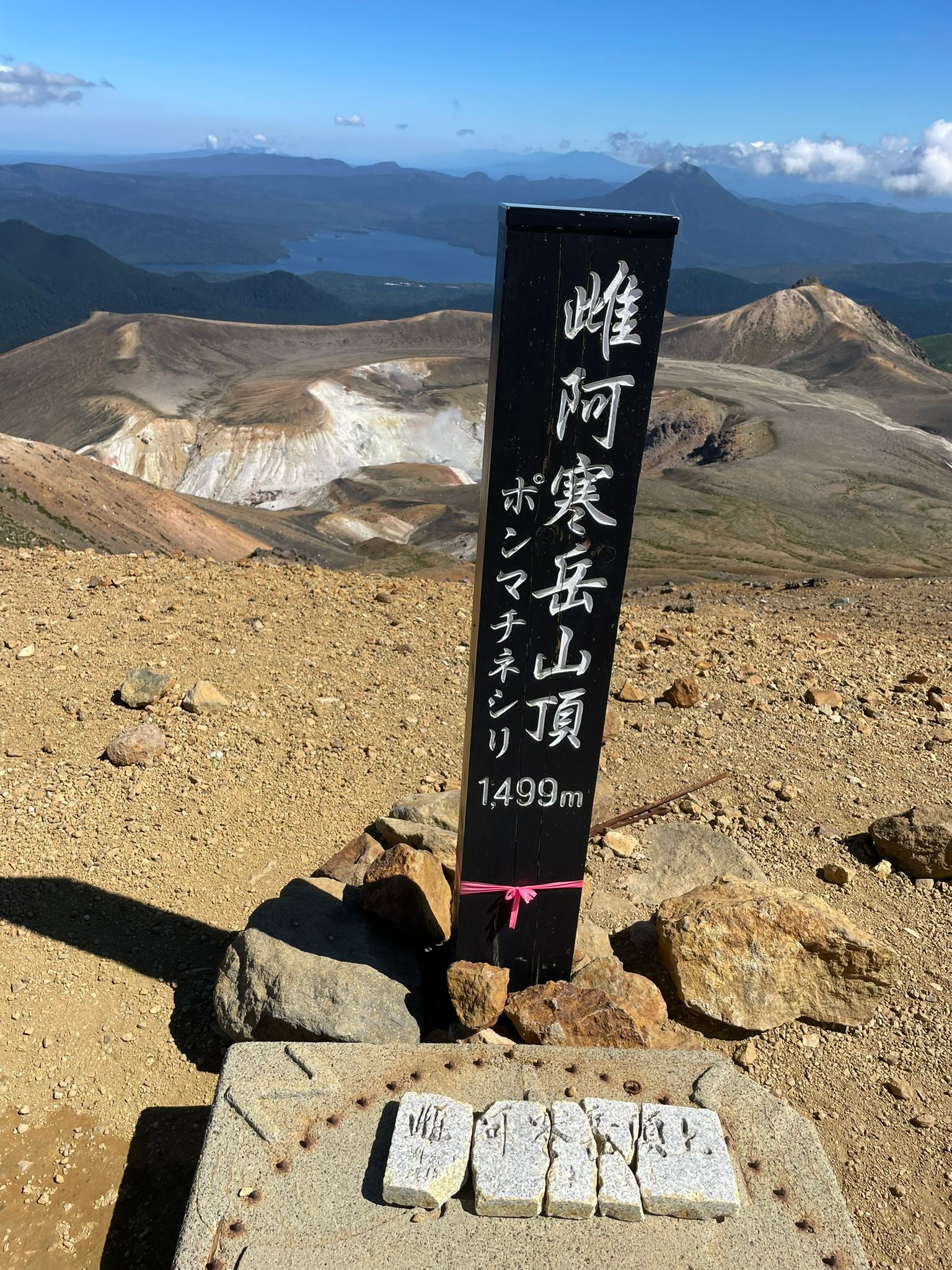
Meakan‑dake is an active stratovolcano rising on the west side of Lake Akan in Akan‑Mashu National Park. Built atop an older caldera system, its summit features a 1.1‑km‑wide outer crater formed by the Nakamatne‑shiri eruption, along with a second crater, a lava dome, and a third crater opening to the northwest. Several parasitic cones — Kitayama, Nishiyama, and Pommatne‑shiri — line the southern flank, while Akan‑fuji stands just to the south and the dammed lakes of Onneto and Ponto sit at the western foot. In Ainu tradition, Meakan is Matne‑shiri (“female mountain”), paired with Oakan‑dake’s Pinne‑shiri (“male mountain”) across the lake.
The mountain is defined by an unusually low treeline, broad volcanic scree, and wide belts of dwarf stone pine. Despite the harsh terrain, alpine plants such as Potentilla miyabei, Meakan carnations, and Meakan‑kinbai thrive here — several of them first collected and named on this mountain in the late 19th century.
This route follows the classic traverse from Meakan Onsen to the summit and down to Onneto. The trail begins in tall Ezo spruce, climbing steeply along moss‑covered roots with understory plants like Cornus canadensis and Pyrola renifolia. Around the 2nd station, the forest transitions into tunnels of dwarf stone pine; by the 4th station, the view opens onto a wide scree slope lined with alpine species such as Rhododendron tomentosum, Pleuropteropyrum ajanense, and Pennelianthus frutescens.
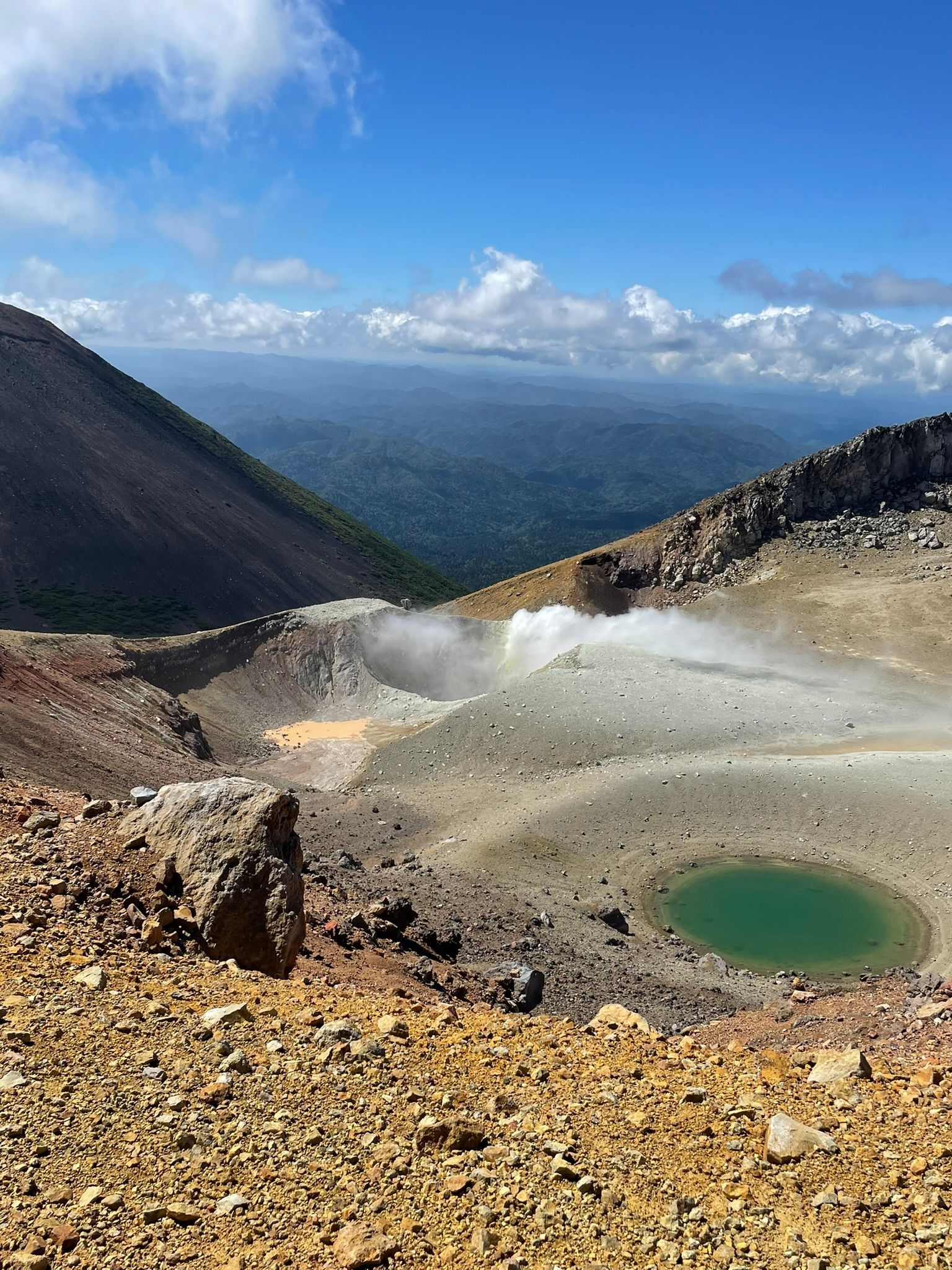
Near the summit, the trail skirts the rim of Meakan’s dramatic caldera, where the colorful ponds of Aka‑numa and Ao‑numa sit among steaming fumaroles. Continuing around the eastern rim, the route meets the trail from Lake Akan and soon reaches the Akan‑fuji junction — a short, optional climb to the top of the black volcanic cone.
From the junction, the descent toward Onneto crosses a scree field dotted with Dicentra peregrina before reentering dense spruce forest. Occasional openings reveal the bright blue waters of Onneto below. After a long forested descent, the trail emerges near the Onneto Campsite Bus Stop, completing the traverse.