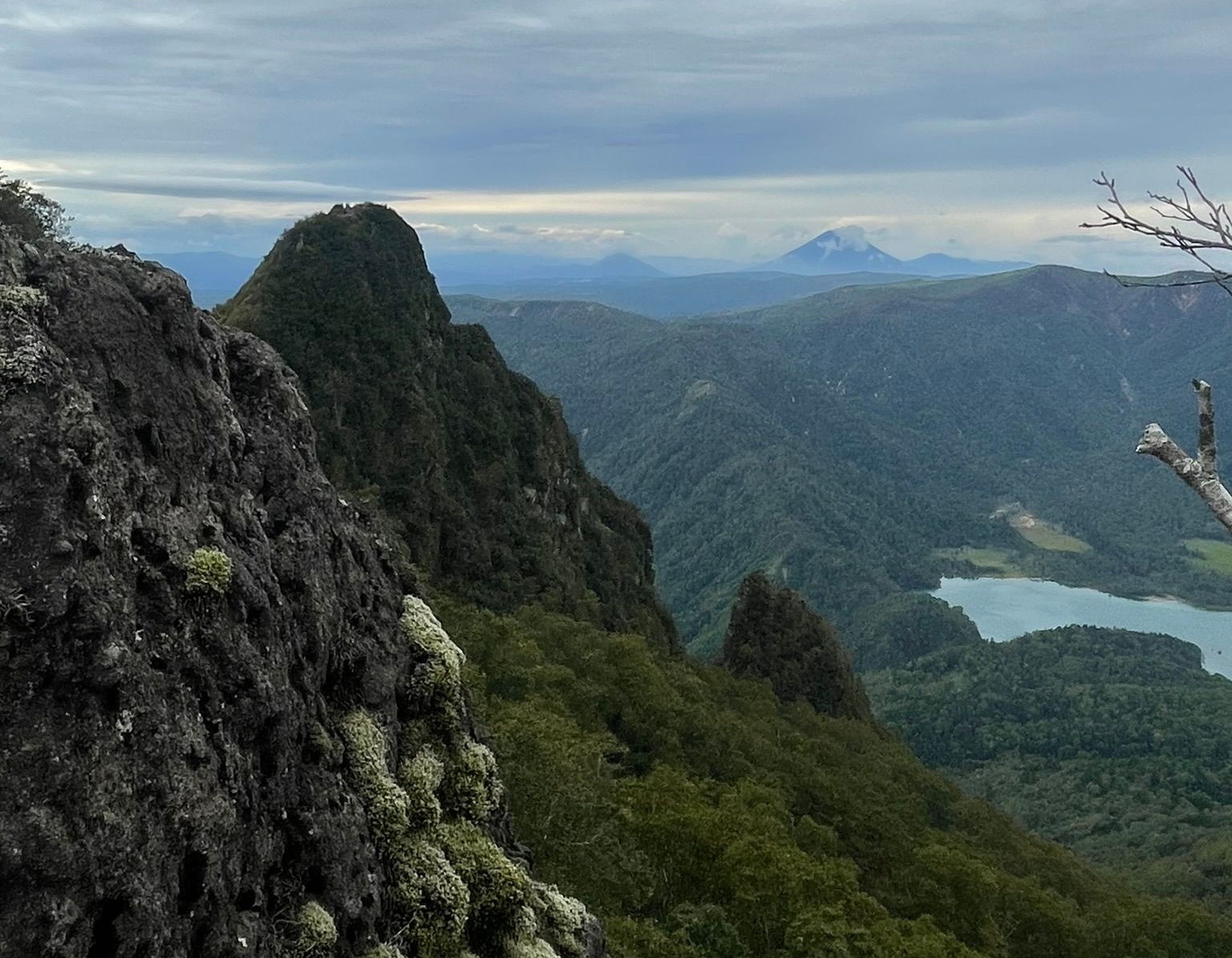
Mountains of Hokkaido
Hiyamizu-sawa (冷水沢) trail to Hoheikyo Dam Loop.
(6.2kms) This forest hike is for those who want to experience some of the Hokkaido wilderness close to Sapporo but may feel a hike up to a mountain peak is a bit too much for their experience or fitness level. This is a perfect half day experience and is best completed with a visit to one of the hot springs to get the full Dosanko vibe.
This route starts at the same trailhead as Sapporo-dake at the Hoheikyo Dam road, just before the carpark.
The first 30 minutes leads up along the river until we reach the forestry trail that will eventually lead back down to the far shore of the dam. We take a right at the forestry trail and enjoy a leisurely pace through the forest enjoying a wide variety of flora and fauna.
On this forest hike which is in the Shikotsu‑Toya National Park, you move through rich mixed woodland dominated by Sakhalin fir, Yezo spruce, and Erman’s birch, with pockets of Japanese oak and maple on warmer slopes. The understory is dense in places, often lined with Sasa bamboo that forms bright green corridors along the trail. In spring and early summer, the forest floor comes alive with dogtooth violets, white anemones, may lilies, and clusters of mizubashō (Asian skunk cabbage) in wetter hollows. Higher on the ridges, the vegetation shifts to alpine shrubs, dwarf stone pine, and hardy species like lingonberry and crowberry, while mosses and lichens cover fallen logs and volcanic rock. Throughout the season, hikers can spot rowan, mountain ash, and wild viburnum, along with seasonal highlights such as Ezo azalea and chishima tsutsuji (alpine rhododendron) in bloom. Together, these layers create the lush, cool, and distinctly Hokkaido forest atmosphere that defines the Shikotsu‑Toya landscape. This trail follows the contour lines for the most part for a further 4 kms before we reach the dam lake.
Passing the museum that showcases the dam's construction, we then walk back through a series of tunnels to the trailhead starting point. If you are so inclined, for a small fee there is an electric shuttle bus that can be taken form the dam to the starting point.
Difficulty-3/10
Muine‑dake (無意根山) .
The climb to Muine‑dake (1460masl, 13.2kms) from Route 230 begins at the small trailhead set back from the highway next to the University Alpine Clubhouse. This known as thw Usubetsu route. We follow a forestry trail for approx. 4.5 kms up the valley passing alpine tarns and an occasionally smelly hot spring set off the trail, before reaching the small trailhead hut. Again, like manly of the trails in Hokkaido, we may encounter the local fauna such as shika deer and very rarely Higuma (Hokkaido Brown Bear). But following the correct protocols will ensure we have a safe experience if we do.
A narrow path enters dense mixed forest through marshy terrain with the occasional alpine tarn and a few creek crossings with the aid of ladders. Once we negotiate this terrain we reach the site of the old university mountain hutte (sansou) which unfortunately burnt down in November of 2024. Once we pass this area, we ascend a series of wooden ladders and steps to reach the lower section of the Muine-dake massif and immediately start a steady ascent along a broad ridge trending generally southwest. The lower section is well‑defined, with firm soil and intermittent root systems, gaining elevation gradually as the ridge rises above the valley. After 30–40 minutes, the gradient increases and the trail transitions into longer, more sustained climbs, with occasional openings in the trees offering early views toward Sapporo Lake and the surrounding foothills.
Around the 900–1,000 m mark, the forest begins to thin and the ridge broadens, leading to a series of undulating rises that form the mid‑mountain approach. This section can feel long, with several false summits and exposed stretches where wind and lingering snow may persist into early summer. The terrain shifts to volcanic gravel and low alpine shrubs as the route approaches the final shoulder, where the trail bends west and begins the main summit push. The last ascent is a steeper, more direct climb up a rocky slope with loose footing in places, requiring careful steps but no technical scrambling.
The summit of Muine‑dake is broad and open, offering panoramic views toward the majestic Yoteizan (Ezo Fuji), Kimobetsu-dake, Yoichi‑dake, the Jōzankei valley, and the Toyohira River watershed. The descent follows the same route, with particular attention needed on the upper loose sections and the long mid‑ridge undulations, which can be tiring on the return.
Difficulty-6.5/10
Jōzankei Tengu‑dake .
Jōzankei Tengu‑dake (定山渓天狗岳) (1145m.a.s.l., 9.5km distance) sits on the southern edge of the Sapporo Volcanic Group, a landscape formed by repeated eruptions and uplift over hundreds of thousands of years. The rugged cliffs and exposed rocky spine near the summit are remnants of ancient volcanic activity that shaped the Toyohira River valley. The steep, narrow ridges that hikers climb today are classic features of Hokkaido’s older volcanic terrain.The mountain overlooks Jōzankei Onsen, founded in 1866 by the monk Miizumi Jōzan, who discovered hot springs in the valley and established a small healing retreat. As the onsen town grew, so did interest in the surrounding mountains. By the early 20th century, Tengu‑dake had become a popular training peak for local mountaineers and students from Sapporo.
Today, it remains one of the closest “real mountain” experiences to the city — steep, scenic, and accessible without long travel. The route to Jōzankei Tengu‑dake begins from the small gravel parking area with a trail hut not far from the base of the mountain, where a well‑cut trail enters mixed forest and immediately starts climbing along a series of secondary streams that lead up to a narrow set of small bluffs.
The first section is a steady ascent on firm soil with occasional roots, gaining elevation quickly as the ridge narrows. After roughly 30–40 minutes, the gradient steepens and the trail transitions into a series of short switchbacks, before entering a deep, steep re-entrant/gully. The climb becomes more pronounced here as it is a steep, steady ascent up the rocky terrain.
Around the 900–790 m mark, the forest begins to thin, and the terrain shifts to rough volcanic rock and low alpine shrubs. The trail remains obvious but becomes looser underfoot, with small scree patches and exposed sections where caution is needed, especially in wet conditions. The final approach follows a small chute to the right of a tight saddle trending east toward the summit block, where the path steepens for the last 10 minutes before topping out on the compact summit plateau. From the summit, views extend toward Mt. Soranuma, Mt. Muine, and the surrounding ridgelines. The descent follows the same route, with particular care required on the upper rocky section and the steep forested ridge, both of which can be slippery when damp or when the first snow falls in early November.
Difficulty-7/10.
Bannosawa-dake.
Bannosawa-dake 盤ノ沢岳(ばんのさわだけ)is a minor peak on the southern outskirts of Sapporo rising to 939 m.a.s.l. This is a great 3 hour hike that can be done and dusted by mid-morning giving you a chance to explore the beautiful forest in the Toyotaki/Bannosawa valley below. This feature is the remnants of a crater rim that makes up the Jozankei volcanic area with other peaks such as Kamui-dake to the west. This is why Jozankei still has geothermal activity with its many onsen. This valley seems to have a higher population of Higuma (Hokkaido Brown Bear) and Shika (deer) than other valleys in the region, as every time I come here, I see bear sign. But there is no need to worry if you follow the correct bear awareness protocol. There are many mineral rich springs in this valley, so the mineral licks that are found around them provide much needed nutrients for the wildlife.
The summer route starts at the same forestry road as the Sapporo-dake north route. After about 600 metres on this trail, we take a left and follow a logging trail that windings itself around the lower bluff and link up with the winter route trail that comes up from the Bannosawa spring temple further down the valley. Rhododendrons are prolific in this forest and late spring/early summer is alive with them. Sakhalin firs (Abies sachalinensis, トドマツ) can be found all through the area here and attract a wide variety of birdlife.
As we head off the logging track and onto the trail itself, we start to gain the altitude quite rapidly before reaching a small saddle after around 15 minutes. the next section is quite steep, and you'll be using the roots of the trees to help you climb in places. There is also a section of the trail that passes over the top of a land slip where the terrain to the left is vertical and care must be taken. This section leads us up to the top of the ridgeline and on top of the old crater rim that was a part of a series of volcanoes many thousands of years ago. We follow this razorback ridge the whole length for approx. 500m before reaching our goal.
Take in the peaks of Sapporo-dake, Soranuma-dake, and the snow-capped Muine-dake to the southwest. There are also great views of the south suburbs of Sapporo as well as the Ishikari plain.
Once a snack is consumed we return in the same trail back to finish off with an onsen visit.
Tarumae to Fuppushi-dake.
Tarumae-san (樽前山), a broad-sloped volcano on the southern edge of Lake Shikotsu (支笏湖) caldera, erupted explosively during the Edo Period, dumping a huge amount of ash and rock on the area around Tomakomai and Chitose. The unique lava dome was created in the 1909 eruption; and even today the volcano remains active and a source of apprehension. The name of the mountain is probably related to the Ainu taru-mai, but the meaning of such a word is unclear. On the other hand, the volcanically extinct Fuppushi-dake (風不死岳), covered thickly with evergreen forest, definitively comes from the Ainu fup-ushi, meaning 'place where the Sakhalin firs (Abies sachalinensis, トドマツ) grow rampantly.'
My personal favorite route is the direct north route straight up to the summit of Fuppushi-dake from the southeastern shore of Shikotsuko. This gains a lot of elevation quite quickly, is way less crowded, and is relatively cooler than the Tarumae route due to the abundant tree cover. Plus, the last 100 metre section before the summit requires concentration and extra physical effort as you need to traverse the top of the old lava chute and cliffs. But here I will explain in more detail the Tarumae-san traverse.
Since it's possible that due to volcanic activity, the hiking trails may be closed, we always check the reports before heading out to the mountain. The trailhead sits at Tarumae-san's 7th station marker (7合目), which is to say that the trailhead is 7/10 of the way up the mountain. Since the approach is so easy, Tarumae-san has lately become a very well-climbed mountain, and overuse is becoming a problem. Please be careful not to tread on any plants off-trail and to pack all your trash out with you and dispose of it responsibly.
After passing through a stand of Alnus japonica (ミヤマハンノキ), you'll come out onto a long slope covered with eruption ejecta but across which you'll have a practically unobstructed view. On Tarumae-san's characteristic broad slope you'll see flowers like Pennellianthus frutescens (イワブクロ or タルマエソウ, named after the mountain), Japanese wintergreen, (Gaultheria pyroloides, シラタマノ キ), and wild rosemary (Ledum palustrum, イソツツジ) among other such volcanic-growth plants.
After a short while climbing, you'll come to the outer rim of the crater, where you can almost fall into the view of the billowing smoke from the lava dome. From here you'll probably get a good idea of how alive the mountain is. It's said, in fact, that during the 1667 eruption, the smoke blew as high as the stratosphere and the rumbling could be heard in Aomori.
Since the crater is off-limits, we'll climb over Higashi-yama (東山) and around the north rim of the crater towards Fuppushi-dake.
After descending an easy scree-covered ridge, we'll traverse the eastern slopes of the descriptively-named 932-Meter Peak and pass a junction, heading out across a saddle ridge toward Fuppushi- dake. Past the saddle you'll enter a forest of Erman's birch (Betula ermanii, ダケカンバ) and proceed up a steep slope to an undulating ridgeline. This ridgeline will bring us to the summit of Fuppushi-dake. The summit is covered low trees, so, looking back towards Tarumae-san, you should get a good sense of how different these two mountains really are.
For the trip back, head back to that junction and take the trail heading directly to the 7th station marker trailhead. This trail traverses the long flank of Tarumae-san and weaves among endless clusters of wild rosemary, which in mid-June look spectacular. That such beautiful plants can live on the flanks of an active volcano makes this a moving part of the hike.
After an easy traverse, you'll end up back at the trailhead.
Eniwa-dake
Eniwa-dake (恵庭岳, Eniwa-dake) is an volcanically active mountain sitting on the northwestern shores of Lake Shikotsu-ko (支笏湖, Shikotsu-ko). Along with it's siblings Mt. Fuppushi-dake (風不死岳, Fuppushi-dake) and Mt. Tarumae-zan (樽前山, Tarumae-zan)--and indeed, the lake itself--Mt Eniwa-dake is the product of enormous volcanic activity some 40,000 years ago. This eruption--and many, many ensuing ones--have shaped the geology and scenery of the area around the lake, and perhaps nowhere is this more evident than on the western slopes of Mt. Eniwa-dake, where a lava flow dammed up the small Okotanpe River to create Lake Okotanpe-ko (オコタンペ湖, Okotanpe-ko).
Eniwa-dake's name comes from its Ainu name: e-en-iwa, meaning 'mountain with a pointed head'. From below, its summit indeed does seem to pierce the sky, giving it an instantly recognizable silhouette from miles away.
The trail runs from the huge crater of Lake Shikotsu-ko up a ridge formed by the left bank of the Porobinai-sawa Beck (ポロビナイ沢, Porobinai-sawa). Some years back, a crag along the upper part of the mountain had collapsed, so everywhere beyond No. 2 Miharashi-dai (第二見晴台, Dai-ni miharashi-dai) had been closed by the trail managers.
From the trailhead you'll head along a dried-up riverbed through a massive jumble of deadwood and scrub from previous landslides before the climb begins in earnest. Note the tiny white snakeberry flowers and the yellow short-stipule violets trailside in the early- to mid-summer.
You'll hit a steep slope as you move into and through a forest of the dark Sakhalin fir before coming out onto a large rock slab and further to the spine of a sharp ridge. While the going might get a little tough, the trail is well-worn and ropes have been installed where some hand-and-foot scrambling is required. Altitude attained, you'll find yourself at Miharashi-dai (見晴台, Miharashi-dai), where the views will open up for the first time.
(You'll often find a Miharashi-dai or two on any given massif in Japan; the word literally translates to 'blue-sky-viewing plateau'.)
From the rocky Miharashi-dai you'll be able to see the summit up ahead of you, above the blown-out volcanic crater itself. Below you, the expansive blue waters of Lake Shikotsu-ko, shining like a giant eye. Keep climbing along Miharashi-dai, and along the rocky trail.
Halfway between station markers 8 and 9, you'll come to the singularly named '8.5th station marker' (八・五合目, 8.5-goume) and the No. 2 Miharashi-dai, beyond is blocked off by fencing due to the unstable ground.
From here the return voyage is down the trail we came up on.
Difficulty- 7.5/10.
Soranuma-dake.
Soranuma-dake (空沼岳) is a peak sitting between the hot springs at Jozankei Onsen (定山渓) and the lake Shikotsu-ko (支笏湖). As this area gets a huge amount of snow in the winter, there are a number of marshes that dot Soranuma-dake's slopes, namely Bankei-numa (万計沼), Mamisu-numa (真簾沼), and the eponymous Sora-numa (空沼). The etymology of the mountain's name is unclear, but it may come from one of two sources: 1) from the old name for the nearby river Izari-gawa (漁川), which the Ainu called raruma-nai (as in (so)raruma, which would have drifted to 'soranuma' over the years), or 2) from a dried-up stream on the mountainside, which would have been called 'Kara-numa' (空沼, lit. 'empty marsh’)—this uses the same Japanese characters as 'Sora-numa' would, and over time the reading may have changed over. At Bankei-numa, there are two huts: Bankei-sansou (万計山荘) and Soranuma-koya (空沼小屋)—the second one id privately run by one of the universities and is not open to the public. You can also make the traverse from Soranuma-dake to Sapporo-dake if you're in the mood for a longer walk.
You'll find the trailhead at the end of a forest road which follows the Bankei-sawa (万計沢) stream. You'll cross a bridge and climb up into a mixed forest of evergreens and broadleaves; but it's the huge Ezo spruce around here that will really catch your eye. With a forest like this it's little wonder that Sapporo is known for its sprawling nature.
From the right bank of the stream you'll shortly cross to the left bank. A little ways after this, you'll leave the side of the stream for a bit; when you meet back up with it you'll have arrived at the small pond called Bankei-numa. In the trees by the shore of the pond lie big Bankei-sansou lodge and the smaller Soranuma-koya hut. If you can spare the time, taking a couple of days to hike the mountain and staying overnight at Bankei-sansou is a lovely way to spend your time.
A little ways above Bankei-numa you'll find the comparatively larger pond called Mamisu-numa. After wandering along the banks of the sprawling pond, the trail will head up a steep slope. You'll emerge on a ridgeline looking down onto the tops of trees. On this ridge you'll run into the junction with the trail from Sapporo-dake (札幌岳) before shortly thereafter reaching the summit of Soranuma-dake. Please note that this is the summer route. It is extremely hazardous to attempt this route in winter as there are avalanche areas and terrain traps. The winter route moves further to the west of the ridge to a slight saddle.
Though it doesn't have much of the feel of being a major summit, the view from the top is outstanding. In particular, the mountains around Shikotsu-ko, especially Eniwa-dake (恵庭岳), are spectacular to see. Which is not to mention the hills around Jozankei or the massive cone of Yotei-zan (羊蹄山), Hokkaido's Mt. Fuji, in the distance. At times you may even see the head of a chipmunk or two poking out of the surrounding foliage.
If you were to continue along the ridge from the summit, you'd soon see the pond called Sora-numa as well; but there is no trail down that way. Your trip down will follow the same trail you came up.
Difficulty-6/10
Sapporo-dake.
The western slopes of Sapporo-dake (札幌岳) (1293masl, 11kms) are marked by their long, graceful ridgelines, while the north face is clearly visible from the southern suburbs of Sapporo City. The name of the mountain probably comes from the old Ainu name for the Toyohira River (豊平川), the headwaters of which river are to be found here. Before the Meiji-era colonization of Hokkaido by the Japanese, the Toyohira River was called sat-poro-pet, meaning 'big, dry river.'
As the mountain sits quite close to the popular onsen town of Jozankei (定山渓) and the similarly popular Hoheikyo Onsen (豊平峡温泉), and as the mountain can be climbed as a day trip from Sapporo, it's one of the more popular hikes on the island. Furthermore, the trails passes the quaint Hiyamizu-goya mountain hut (冷水小屋), lying alongside the Hiyamizu-sawa (冷水沢). This hut is not open to the public, unless you first organize with the Hokkaido University. The traverse from the summit to nearby Soranuma-dake (空沼岳) in the east is an easy hike in summer and a lovely ski-touring trip in winter.
From National Route 230 (国道230号線), heading in towards Hoheikyo Onsen, you'll find the trailhead just before the Hiyamizu Tunnel (冷水トンネル) which services Hoheikyo Dam.
The first half of the hike consists of a refreshing walk alongside the Hiyamizu-sawa. In early spring, Anemone flaccida (ニリンソウ) and Trillium tschonoskii (ミヤマエンレイソウ) bloom along here. At 750 meters in elevation you'll arrive at Taifuu-kogen (台風高原), a reclaimed forest of Sakhalin fir (Abies sachalinensis, トドマツ) and Erman's birch (Betula ermanii, ダケカンバ). In 1954 the typhoon Toya- maru (洞爺丸) knocked down the greater part of the forest here; the current forest along this plateau grew from the deadfall. You'll ford the stream a number of times through here before arriving at Hiyamizu-goya. Though the hut here stands two stories tall it's built from local lumber and blends in with the surrounding forest.
From Hiyamizu-goya onwards the trail starts to get quite steep. You'll pass through first a conifer forest and then a grove of twisted Erman's birch. Winters bring a lot of snow in these mountains, so even in mid-May you'll probably see a good deal of snow on the lee sides of the ridgelines. Across the deep valley of Hoheikyo, you should be able to see Muineshiri-yama (無意根 尻山).
From the summit of Sapporo-dake, you'll find a view out over Jozankei and the city of Sapporo. Among the old dwarf stone pine (Pinus pumila, ハイマツ)on the summit, you'll encounter a peace you wouldn't think could be found within the Sapporo city limits.
There is also a northern route which starts in the Bannosawa valley which used to run by the Toyotaki Falls (豊滝), but this trail has since been diverted due to a major landslide. This route is still open and is a much steeper and challenging ascent. I highly recommend this route if you are after a decent work out. This trail meets the Sapporo-dake/Soranuma-dake trail just east of Sapporo-dake summit.
The trail down is the same one you took up for both routes or it is a long walk/bus ride back to the start!
That all being said, there are a number of small, pleasant mountain huts around here; and walks along the streams and ridgelines of the area, especially in late spring or at the changing of the leaves in the fall, can make for incredible weekend treks.
If you're heading to Soranuma-dake in the east, it's worth taking your time and stopping at a mountain hut along the way.
Difficulty-5/10